

How Often Are New AI Models Released? The 2026 Release Timeline
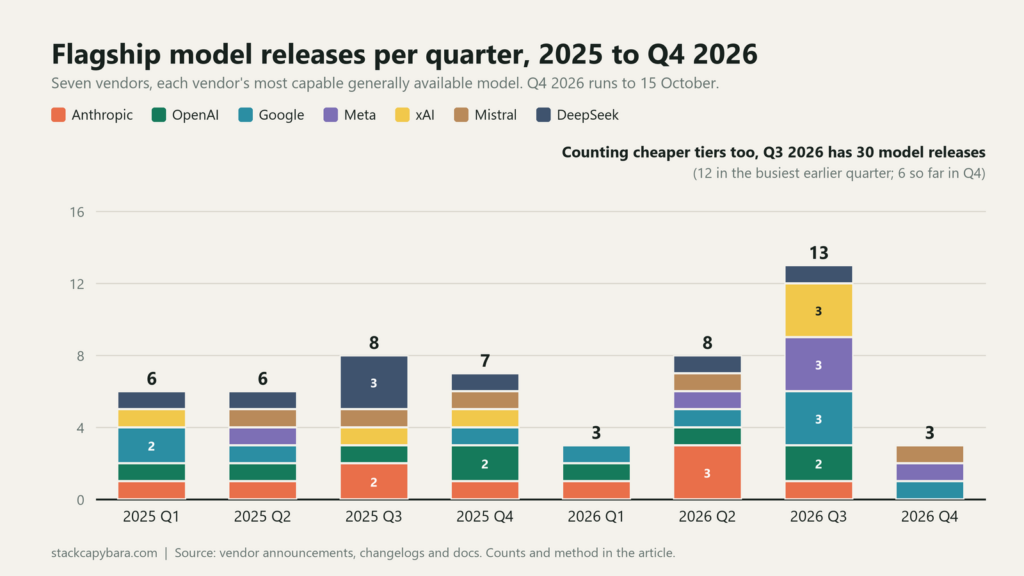
As of 15 October 2026. Model releases have sped up sharply, flagship steps only modestly: the median gap between a vendor’s most capable generally available models was 66.5 days for releases in 2026 against 85 days for 2025, while Q3 2026 holds 30 model releases once cheaper tiers are counted, against 12 in the busiest earlier quarter. It matters if you pay an API bill and have to decide how often to re-test the models you run. The figures cover seven vendors and come from dated vendor announcements (method at the end of the page).
The past fortnight shows the split. Between 6 and 13 October, three vendors each released a new flagship: Mistral Large 4 (6 October, a public preview), Meta’s Muse Wonder (12 October) and Google’s Gemini 4 Argon (13 October, generally available). Anthropic’s Claude Haiku 5.5 (7 October) is a cheaper tier, not a flagship, but it cut the price of its tier by 90% on prompts up to 100K tokens. We found no new text model from OpenAI, xAI or DeepSeek since 30 September; xAI’s only release was a speech model, Grok Voice 3.0, on 14 October. Q4 holds 6 releases so far counting cheaper tiers, in 15 days: about 12 per 30 days, against 9.8 per 30 days for Q3’s 30 in 92 days, though 15 days is too short to read as a trend. Our position: a faster calendar is not a reason to chase every launch.
Price changes and deprecation notices, both published on the vendor’s own pages, are better triggers for re-testing than a launch day. For a launch-by-launch record from 1 August to 25 September, see our dated log of new AI releases.
Recent releases: 30 September to 15 October 2026
Gemini 4 Argon (gemini-4-argon) became generally available on 13 October, per the Gemini API changelog, which calls it “our most capable model built for complex coding, agentic, math, and science tasks”. Google’s 30 September post was a limited rollout to trusted cyber defenders, with no model ID, so we date Argon to the October step. The model page lists a 1,048,576-token context window. The pricing page shows $2 input and $10 output per million tokens through 30 November, then $4 and $20 from 1 December.
Muse Wonder is Meta’s new model, announced on 12 October. Meta’s post calls Muse Wonder and Muse Wonder Full “our most capable models that deliver state-of-the-art performance on personal and professional agentic tasks”. Muse Wonder is available through the Meta Model API and Muse Code, and Muse Wonder Full to Muse Code subscribers. The post states no price.
Mistral Large 4 (mistral-large-4) entered public preview on 6 October. Mistral calls it “our largest and most capable model to date” and says the weights will be released by the end of October. Its changelog describes an open-weight multimodal mixture-of-experts model with a 1M context window. Mistral’s Hugging Face page listed no Large 4 weights when we checked on 15 October. Mistral’s announcement lists $1.36 input and $4.18 output per million tokens; its changelog adds a 50% launch discount for two weeks without saying whether the listed price is before or after it.
Claude Haiku 5.5 (claude-haiku-5-5) launched on 7 October at $0.10 per million input tokens and $0.50 output for prompts up to 100K tokens, and $0.50 and $2.50 above that, per Anthropic’s announcement. Claude Haiku 4.5 lists at $1 and $5, so the small tier is 90% cheaper on short prompts and 50% cheaper on long ones; Anthropic says Haiku 5.5 costs around 75% less to run on average. Its input rate on short prompts is a twentieth of Sonnet 5.5’s $2. The same day, Anthropic’s release notes record Sonnet 5.5 cache reads falling from $0.20 to $0.10 per million tokens.
Other changes. On 8 October OpenAI added an Ultrafast mode for GPT-6.1 Sol, listed on its pricing page at $12 input and $60 output, 6x the standard $2 and $10. The same day Google deprecated Gemini 3.7 Flash, 56 days after its 13 August release, and Gemini 3.5 Flash, routing requests to Gemini 3.8 Flash and 3.6 Flash. The changelog gives no shutdown date for either.
Grok Voice 3.0. On 14 October xAI’s release notes list grok-voice-3.0, a Speech to Speech model, at the same price as Grok Voice 2.0. The grok-voice-latest alias now points to it and Grok Voice 2.0 is deprecated. It is a speech model, not a Grok text model, so it counts in the broader tally and not in the flagship series.
Where we found nothing. OpenAI: its API changelog lists no new model after GPT-6.1 Sol on 29 September, so GPT-6 Astra stays its most capable. xAI: the release notes list no new Grok text model since Grok 4.7; the only model entry since then is Grok Voice 3.0, a speech-to-speech model released on 14 October. DeepSeek: the updates page has no entry after 10 September. Alibaba’s Qwen 4, said on 22 September to be in training, has not appeared: the Qwen organisation on Hugging Face has no Qwen 4 model.
Claude Opus 5.5, Claude Sonnet 5.5 and GPT-6.1 Sol
Claude Opus 5.5 (claude-opus-5-5) arrived on 22 September at $4 per million input tokens and $20 per million output, which Anthropic’s announcement calls 20% below Opus 5. Anthropic also claims it costs 40% less than Opus 5 on typical workloads; we have not measured that. It is not a drop-in swap: the model docs list four breaking changes, including no way to disable thinking.
Claude Sonnet 5.5 (claude-sonnet-5-5) followed on 28 September at the same $2 and $10 as Sonnet 5. Anthropic claims it runs 30% or more faster and costs up to 30% less for most work. Its model overview lists five breaking changes of its own, including that forced tool use now returns an error.
GPT-6.1 Sol (gpt-6.1-sol) launched on 29 September at $2 and $10, the same as GPT-6 Sol except that cached input halves to $0.10. OpenAI says it nearly matches GPT-6 Astra on agentic coding, computer use and professional work at one-fifth of Astra’s standard prices, and it does not replace Astra, which OpenAI’s changelog calls its most capable model. The model page lists text and image input only, and no none or minimal reasoning settings.
Artificial Analysis, an independent benchmarking site, scored Opus 5.5 at 58 on its Intelligence Index (first of 216 models, at max effort), Sonnet 5.5 at 56 (second, at max effort) and GPT-6.1 Sol at 50 (eighteenth, at high effort), all captured on 15 October. Each vendor’s own benchmark table picks its own rivals and settings, so do not read one vendor’s numbers across to the other’s.
| Claude Opus 5.5 | Claude Sonnet 5.5 | GPT-6.1 Sol | |
|---|---|---|---|
| Released | 22 Sep 2026 | 28 Sep 2026 | 29 Sep 2026 |
| Input | $4 | $2 | $2 ($4 above 272K input tokens) |
| Cached input | $0.20 | $0.10 (was $0.20 until 7 Oct) | $0.10 ($0.20 above 272K) |
| Output | $20 | $10 | $10 ($15 above 272K) |
| Batch (input / output) | $2 / $10 | $1 / $5 | $1 / $5 |
| Versus its predecessor | 20% below Opus 5 ($5 / $25) | Unchanged from Sonnet 5 | Unchanged from GPT-6 Sol; cached input halved |
| Context window | 1M tokens | 1M tokens | 1,050,000 tokens (922K max input) |
| Max output | 128K (300K on Batch, beta) | 128K (300K on Batch, beta) | 128,000 |
| Knowledge cutoff | June 2026 | June 2026 | 30 April 2026 |
| Artificial Analysis Intelligence Index (captured 15 October) | 58 (1st of 216, max effort) | 56 (2nd of 216, max effort) | 50 (18th of 216, high effort) |
GPT-6.1 Sol vs Claude Opus 5.5: price
On list price, GPT-6.1 Sol costs exactly half of Claude Opus 5.5: $2 against $4 per million input tokens, $10 against $20 per million output tokens, $0.10 against $0.20 for cached input.
The gap closes on long prompts. Above 272K input tokens OpenAI charges 2x on input and 1.5x on output for the whole request, while Anthropic’s release notes say models from Opus 4.6 onward get the full 1M window at the standard price. At list price, with no caching or batch discount:
| Request | Claude Opus 5.5 | Claude Sonnet 5.5 | GPT-6.1 Sol |
|---|---|---|---|
| 100K input, 10K output | 0.1 × $4 + 0.01 × $20 = $0.60 | 0.1 × $2 + 0.01 × $10 = $0.30 | 0.1 × $2 + 0.01 × $10 = $0.30 |
| 300K input, 10K output | 0.3 × $4 + 0.01 × $20 = $1.40 | 0.3 × $2 + 0.01 × $10 = $0.70 | 0.3 × $4 + 0.01 × $15 = $1.35 (long-context rates) |
At 100K tokens Sol costs half of Opus 5.5. At 300K it is 5 cents cheaper per request. List price is also not cost per task. Anthropic says models from 4.7 onward use a tokenizer that produces about 30% more tokens for the same text, and we have not measured Sol’s. OpenAI’s own evaluation reports $5.47 per task for GPT-6.1 Sol against $23.21 for Opus 5.5 on Terminal-Bench Science 0.1, under a quarter, while GPT-6 Astra still leads on score at 68.1%. We have not reproduced that.
Claude vs GPT vs Gemini release dates, 2025 to 2026
Each vendor has a flagship series: at each step, the model the vendor itself describes as its most capable generally available model, dated from the vendor’s own announcement, changelog or docs. A preview or experimental release counts, and so does its later step to general availability. So GPT-6 Sol and 6.1 Sol (below GPT-6 Astra), Claude Opus 5 and 5.5 and Claude Haiku 5.5 (Fable 5 has been Anthropic’s most capable model open to all customers since 9 June, and Anthropic calls Fable 5.1 and Mythos 5.1 “the world’s most advanced models for coding and knowledge work”, Mythos 5.1 being trusted-access only), o3-mini, DeepSeek-V3-0324 (DeepSeek kept R1 for complex reasoning), Mistral Small 3 and 4 and DeepSeek V4.1-Flash are not flagships. A gap is the days since the same vendor’s previous flagship. Dates come from Anthropic’s release notes, the OpenAI API changelog, the Gemini API changelog, xAI’s release notes, Mistral’s changelog, DeepSeek’s updates page and Meta’s Llama 4, Muse Spark 1.2 and Muse Wonder posts.
We left out Alibaba’s Qwen line, which we could date only from Wikipedia, and xAI’s Grok 4.20 and Grok 4.3, which xAI’s release notes date only to a month with no year, or not at all. Flagship counts on this page are therefore floors.
| Vendor | Flagship | Release date | Days since previous |
|---|---|---|---|
| Anthropic | Claude 3.7 Sonnet | 2025-02-24 | 125 |
| Anthropic | Claude Opus 4 | 2025-05-22 | 87 |
| Anthropic | Claude Opus 4.1 | 2025-08-05 | 75 |
| Anthropic | Claude Sonnet 4.5 | 2025-09-29 | 55 |
| Anthropic | Claude Opus 4.5 | 2025-11-24 | 56 |
| Anthropic | Claude Opus 4.6 | 2026-02-05 | 73 |
| Anthropic | Claude Opus 4.7 | 2026-04-16 | 70 |
| Anthropic | Claude Opus 4.8 | 2026-05-28 | 42 |
| Anthropic | Claude Fable 5 | 2026-06-09 | 12 |
| Anthropic | Claude Fable 5.1 | 2026-09-01 | 84 |
| OpenAI | GPT-4.5 | 2025-02-27 | 72 |
| OpenAI | o3 | 2025-04-16 | 48 |
| OpenAI | GPT-5 | 2025-08-07 | 113 |
| OpenAI | GPT-5.1 | 2025-11-13 | 98 |
| OpenAI | GPT-5.2 | 2025-12-11 | 28 |
| OpenAI | GPT-5.4 | 2026-03-05 | 84 |
| OpenAI | GPT-5.5 | 2026-04-24 | 50 |
| OpenAI | GPT-5.6 Sol | 2026-07-09 | 76 |
| OpenAI | GPT-6 Astra | 2026-09-03 | 56 |
| Gemini 2.0 Pro (exp) | 2025-02-05 | 56 | |
| Gemini 2.5 Pro (exp) | 2025-03-25 | 48 | |
| Gemini 2.5 Pro (GA) | 2025-06-17 | 84 | |
| Gemini 3 Pro Preview | 2025-11-18 | 154 | |
| Gemini 3.1 Pro Preview | 2026-02-19 | 93 | |
| Gemini 3.5 Flash | 2026-05-19 | 89 | |
| Gemini 3.6 Flash | 2026-07-21 | 63 | |
| Gemini 3.7 Flash | 2026-08-13 | 23 | |
| Gemini 3.8 Flash | 2026-09-02 | 20 | |
| Gemini 4 Argon (GA) | 2026-10-13 | 41 | |
| xAI | Grok 3 | 2025-02-19 | 190 |
| xAI | Grok 4 | 2025-07-09 | 140 |
| xAI | Grok 4.1 | 2025-11-17 | 131 |
| xAI | Grok 4.5 | 2026-07-16 | n/a |
| xAI | Grok 4.6 | 2026-08-12 | 27 |
| xAI | Grok 4.7 | 2026-09-21 | 40 |
| Meta | Llama 4 | 2025-04-05 | 256 |
| Meta | Muse Spark | 2026-04-08 | 368 |
| Meta | Muse Spark 1.1 | 2026-07-09 | 92 |
| Meta | Muse Spark 1.2 | 2026-08-05 | 27 |
| Meta | Muse Spark 1.3 | 2026-09-02 | 28 |
| Meta | Muse Wonder | 2026-10-12 | 40 |
| Mistral | Mistral Medium 3 | 2025-05-07 | 170 |
| Mistral | Mistral Medium 3.1 | 2025-08-12 | 97 |
| Mistral | Mistral Large 3 | 2025-12-02 | 112 |
| Mistral | Mistral Medium 3.5 | 2026-04-28 | 147 |
| Mistral | Mistral Large 4 (preview) | 2026-10-06 | 161 |
| DeepSeek | DeepSeek-R1 | 2025-01-20 | 25 |
| DeepSeek | DeepSeek-R1-0528 | 2025-05-28 | 128 |
| DeepSeek | DeepSeek-V3.1 | 2025-08-21 | 85 |
| DeepSeek | DeepSeek-V3.1-Terminus | 2025-09-22 | 32 |
| DeepSeek | DeepSeek-V3.2-Exp | 2025-09-29 | 7 |
| DeepSeek | DeepSeek-V3.2 | 2025-12-01 | 63 |
| DeepSeek | DeepSeek-V4 (preview) | 2026-04-24 | 144 |
| DeepSeek | DeepSeek-V4-Pro (GA) | 2026-08-13 | 111 |
“n/a” marks Grok 4.5, which follows a release we left out, so no gap is shown. The table holds 54 flagship releases. Argon is dated to its general availability, not to Google’s 30 September limited rollout.
Flagship releases per quarter, and all releases
Counting flagship steps only, Q3 2026 has 13 releases: Google, Meta and xAI 3 each, OpenAI 2, Anthropic and DeepSeek 1 each, Mistral none. The busiest earlier quarters, Q3 2025 and Q2 2026, had 8. All of 2025 holds 27 flagship releases and the first nine months of 2026 hold 24, about 7 a quarter in 2025 and 8 in 2026. Q4 2026 has 3 so far, one each from Google, Meta and Mistral, in 15 days; that is too short a span to read as a trend. Flagships are arriving somewhat faster, not sharply faster.
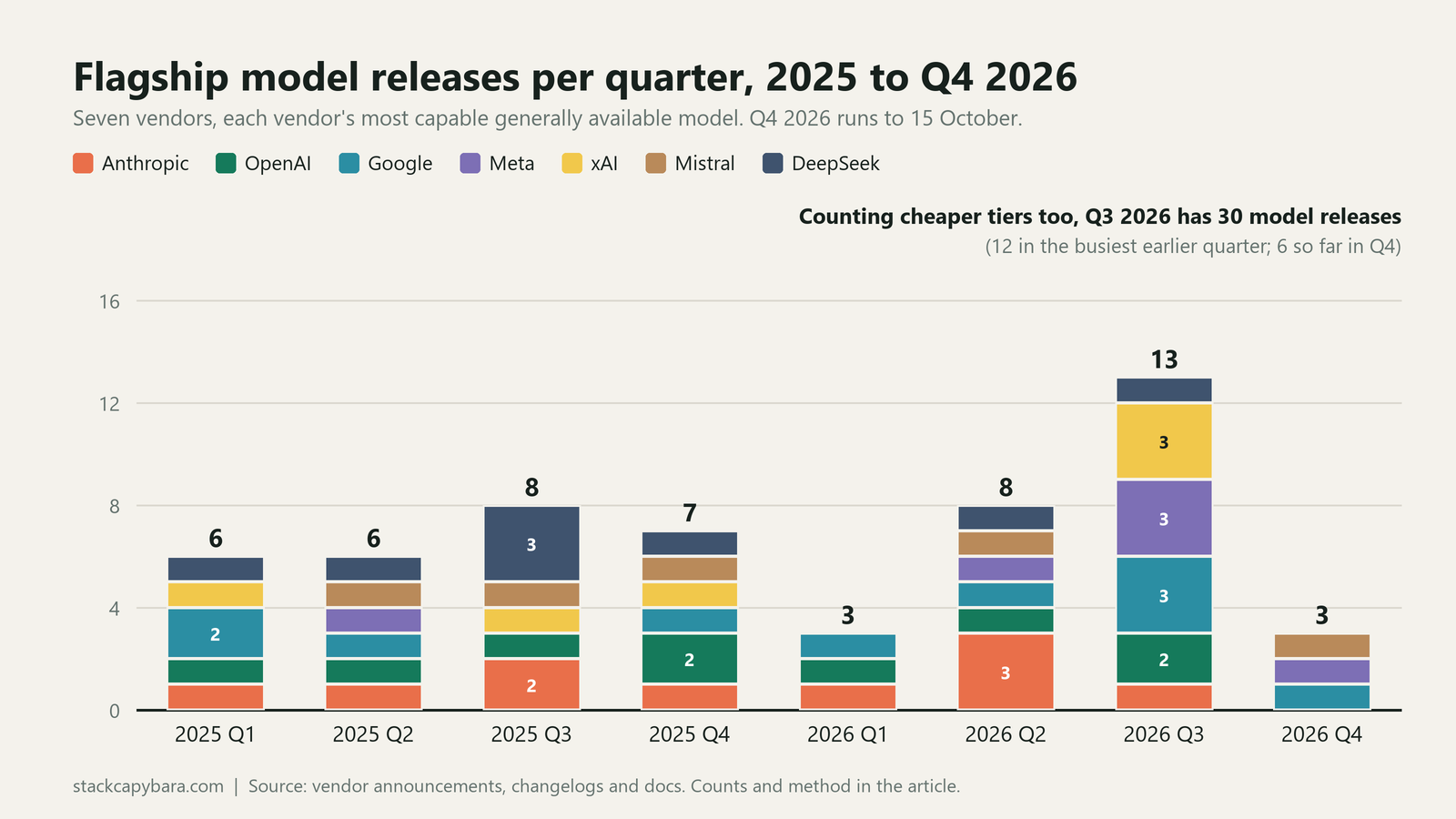
| Quarter | Anthropic | OpenAI | xAI | Meta | Mistral | DeepSeek | Total | |
|---|---|---|---|---|---|---|---|---|
| 2025 Q1 | 1 | 1 | 2 | 1 | 0 | 0 | 1 | 6 |
| 2025 Q2 | 1 | 1 | 1 | 0 | 1 | 1 | 1 | 6 |
| 2025 Q3 | 2 | 1 | 0 | 1 | 0 | 1 | 3 | 8 |
| 2025 Q4 | 1 | 2 | 1 | 1 | 0 | 1 | 1 | 7 |
| 2026 Q1 | 1 | 1 | 1 | 0 | 0 | 0 | 0 | 3 |
| 2026 Q2 | 3 | 1 | 1 | 0 | 1 | 1 | 1 | 8 |
| 2026 Q3 | 1 | 2 | 3 | 3 | 3 | 0 | 1 | 13 |
| 2026 Q4 (to 15 Oct) | 0 | 0 | 1 | 0 | 1 | 1 | 0 | 3 |
The broader count tells a different story. Take every dated model row in our release tables, cheaper tiers and variants included, and Q3 2026 has 30 releases against 12 in the busiest earlier quarters, Q1 and Q4 2025. The first nine months of 2026 hold 51, against 44 in all of 2025, and 57 to 15 October. OpenAI accounts for 8 of the Q3 30, Google 7 and Anthropic 5. Q4 has 6 so far: Meta 2 (Muse Wonder and Muse Wonder Full), and Anthropic, Google, Mistral and xAI 1 each (xAI’s is the speech model Grok Voice 3.0). At 6 in 15 days that is about 12 per 30 days, against 9.8 in Q3, but 15 days is too short to read as a trend. Our tables are not exhaustive, so every count here is a floor. They leave out specialist and open-weight releases we came across while checking, such as Meta’s Muse Glimmer (10 August), OpenAI’s GPT-Rosalind (8 September) and xAI’s earlier speech models Grok Voice 1.0 (April) and Grok Voice 2.0 (July), and we did not add them because that would mean recounting every earlier quarter. The acceleration is mostly in tiers and variants; flagships sped up far less.
AI release cadence by company: days between flagships
The table gives the median gap for flagships landing in each year, with the number of gaps in brackets. Several vendors have only a handful of gaps, so read the medians as a direction, not a precise rate. Pooled across the seven vendors the median is 85 days for 2025 and 66.5 for 2026.
| Vendor | Flagships, 2025 to 15 Oct 2026 | Median gap, 2025 releases | Median gap, 2026 releases | Days since latest flagship |
|---|---|---|---|---|
| Anthropic | 10 | 75 (5) | 70 (5) | 44 |
| OpenAI | 9 | 72 (5) | 66 (4) | 42 |
| 10 | 70 (4) | 52 (6) | 2 | |
| xAI | 6 | 140 (3) | 33.5 (2) | 24 |
| Meta | 6 | 256 (1) | 40 (5) | 3 |
| Mistral | 5 | 112 (3) | 154 (2) | 9 |
| DeepSeek | 8 | 47.5 (6) | 127.5 (2) | 63 |
| All seven (pooled) | 54 | 85 (27) | 66.5 (26) |
Anthropic: the gaps from Claude 3 to Claude 3.7 Sonnet were 109, 123 and 125 days. The five 2026 gaps were 73, 70, 42, 12 and 84 days, and the last, Fable 5 to Fable 5.1, was longer than any of the four before it; Fable 5.1 is now 44 days old. OpenAI went from GPT-5.6 Sol on 9 July to GPT-6 Astra on 3 September, 56 days, and Astra is 42 days old. GPT-6 Sol and GPT-6.1 Sol followed, but they are cheaper models, not flagships.
Google moved its top model to the Flash line. Its launch post calls Gemini 3.5 Flash, released on 19 May, “our strongest agentic and coding model yet, outperforming Gemini 3.1 Pro on challenging coding and agentic benchmarks”, and 3.6, 3.7 and 3.8 Flash followed at gaps of 63, 23 and 20 days. Gemini 4 Argon came 41 days after 3.8 Flash, and the Gemini API changelog calls it Google’s most capable model. Between Gemini 3.1 Pro Preview on 19 February and Argon on 13 October is 236 days. Google said in May it would roll out 3.5 Pro “next month”, and in July that 3.5 Pro “is currently testing with partners”; we found no Gemini 3.5 Pro entry in the changelog. Meta cut its gaps from 368 days (Llama 4 to Muse Spark) to 92, 27, 28 and 40. xAI shipped Grok 4.5, 4.6 and 4.7 at gaps of 27 and 40 days, and Grok 4.7 is 24 days old.
DeepSeek’s median rose from 47.5 to 127.5 days between 2025 and 2026, on two gaps in 2026, and V4-Pro is 63 days old. Mistral’s two 2026 gaps, Large 3 to Medium 3.5 (147 days) and Medium 3.5 to Large 4 (161), give a median of 154; Large 4 is a preview, with its weights still to come. Flagship pace is uneven: Meta and xAI sped up, Google, Anthropic and OpenAI shortened their gaps, and Mistral and DeepSeek slowed.
What the pace means for buyers
Price per token is falling, tier by tier
Holding the tier constant, list prices are dropping fast. Anthropic’s Opus tier went from $15 input and $75 output at Claude 3 Opus in March 2024, and at Opus 4 and 4.1, to $5 and $25 from Opus 4.5 through Opus 5, then $4 and $20 at Opus 5.5: down 73% in two and a half years. The Sonnet tier went from $3 and $15 to $2 and $10, down 33%. The Haiku tier went from $1 and $5 at Haiku 4.5 to $0.10 and $0.50 at Haiku 5.5 for prompts up to 100K tokens, down 90%. OpenAI’s Sol line went from $5 and $30 at GPT-5.6 Sol’s launch on 9 July to $2 and $10 at GPT-6.1 Sol: down 60% on input and 67% on output in 82 days, via a $4 and $20 promotional price from 21 August. Seventeen of Q3 2026’s 30 releases are not flagships, so cheaper tiers and variants are the launches most likely to change your bill.
The frontier itself got dearer. GPT-6 Astra lists at $10 and $50 against GPT-5.5’s $5 and $30, and Claude Fable 5.1 at $10 and $50 against Opus 5.5’s $4 and $20. Epoch AI found in March 2025 that the cost of reaching a fixed performance level fell 9x to 900x a year depending on the milestone. Our tier figures are slower because they hold the tier constant, not the capability.
List price is not your bill: the Claude tokenizer change and introductory rates that end both move it. Gemini 4 Argon’s $2 and $10 is an introductory price that doubles to $4 and $20 on 1 December.
Lock-in: how long a model stays available
Models are retired on a timetable, and a new release is often a migration. Anthropic’s deprecations page shows Claude 3.7 Sonnet retired 360 days after release, Claude Opus 4.1 after 365 days, and Claude Opus 4 and Sonnet 4 after 389 days, with 114 days between announcement and retirement for Claude 3.7 Sonnet and 61 to 62 days for the others. Anthropic promises at least 60 days’ notice. The same page shows Sonnet 4.5 deprecated on 30 September, retiring on 30 November 2026. Previews are shorter: Gemini 3 Pro Preview shut down 111 days after its release on 18 November 2025, and Google deprecated Gemini 3.7 Flash 56 days after release, with no shutdown date given. The breaking changes above are the other half of lock-in, so budget test time for each move.
When to re-benchmark
We would re-test on a trigger, not on a launch day:
- Your vendor ships a model in your tier at the same or a lower list price, as Sonnet 5.5, GPT-6.1 Sol and Haiku 5.5 did.
- The price of the model you run changes or a promotional rate ends. GPT-5.6 Sol’s promotional price runs to at least 21 November, Gemini 4 Argon’s introductory price ends on 30 November, and the Gemini 3.6 and 3.8 Flash introductory rates double on 1 January 2027.
- A deprecation notice arrives. Anthropic promises at least 60 days; its last three retirement notices gave 61 or 62.
- The vendor makes a breaking API change to a model you depend on.
A launch that only raises a leaderboard score is not on the list. With 30 model releases in the latest quarter, a 90-day review cycle will see about that many go by, so check price sheets on that cycle and test only when a trigger fires.
Keep a fixed set of your own prompts, record the token counts of each run, and put those volumes through the LLM API cost calculator. Check the price date under its table first: it says prices are verified through 30 September 2026, before the Haiku 5.5, Sonnet 5.5 cache and Argon changes above. For prices, context windows and cached-input rates side by side, use the AI model comparison, and for what benchmark scores cost per solved task, the AI model cost explorer.
Who this is not for
This is not for readers who want a pick. We have not benchmarked any model named on this page ourselves, so every score above is the vendor’s or Artificial Analysis’s. It is also not for anyone running one stable workload on a model that already does the job at an acceptable price: if none of the four triggers has fired, the release calendar is not your problem.
What is coming next
| Item | Status | Detail |
|---|---|---|
| Mistral Large 4 open weights | Promised by the end of October | Mistral says it will release the weights by the end of the month. None were listed on Hugging Face on 15 October. |
| GPT-5.6 Sol promotional price | Runs to at least 21 November | $4 input and $20 output, against a $5 and $30 launch price, per OpenAI. OpenAI does not state the price after the promotion. That is 37 days from today. |
| Sonnet 4.5 retirement | 30 November 2026 | Deprecated on 30 September per Anthropic’s deprecations page, with Sonnet 5.5 as the named replacement. That is 46 days from today. |
| Gemini 4 Argon introductory price | Ends 30 November 2026 | $2 input and $10 output rise to $4 and $20 on 1 December, per Google’s pricing page. That is 46 days from today. |
| Gemini 3.6 and 3.8 Flash introductory price | Ends 31 December 2026 | $0.75 input and $3.75 output rise to $1.50 and $7.50 on 1 January 2027, per the same page. |
| Claude Haiku 4.5 | Active; no notice yet | The deprecations page lists retirement “not sooner than” 15 October 2026 and no deprecation notice. Anthropic promises at least 60 days’ notice, so a notice issued today would mean retirement no earlier than 14 December. |
| Qwen 4 | Announced as in training; no release found | Alibaba Cloud said so on 22 September, with no date, price or model. |
One report needs careful reading: TechCrunch, citing The Wall Street Journal, says OpenAI scrapped a GPT-6.1 Astra release over safety concerns. No OpenAI page we opened says so, and OpenAI’s pricing page lists no GPT-6.1 Astra as of 15 October.
FAQ
How often are new AI models released?
Counting every dated model release in our tables, cheaper tiers included, Q3 2026 has 30, against 12 in the busiest earlier quarter, and Q4 has 6 in its first 15 days. Flagship steps have sped up far less: the median gap between a vendor’s most capable generally available models was 66.5 days for 2026 releases and 85 days for 2025 releases.
Which AI company releases new models fastest?
By total releases in Q3 2026, OpenAI leads with 8 of 30, then Google with 7 and Anthropic with 5. By flagship gap, xAI has the shortest 2026 median, 33.5 days, from only two gaps; among vendors with four or more, Meta is at 40, Google 52, OpenAI 66 and Anthropic 70.
How much does GPT-6.1 Sol cost compared with Claude Opus 5.5?
GPT-6.1 Sol lists at $2 per million input tokens and $10 per million output tokens, half of Claude Opus 5.5’s $4 and $20. Above 272K input tokens Sol rises to $4 and $15, so a 300K-token request costs about $1.35 on Sol and $1.40 on Opus 5.5 at list price.
Is Gemini 4 out yet?
Yes. Gemini 4 Argon (gemini-4-argon) became generally available in the Gemini API on 13 October, after a limited rollout announced on 30 September. It lists at $2 per million input tokens and $10 output through 30 November, then $4 and $20 from 1 December.
How much does Claude Haiku 5.5 cost?
Claude Haiku 5.5 launched on 7 October at $0.10 per million input tokens and $0.50 output for prompts up to 100K tokens, and $0.50 and $2.50 above. Claude Haiku 4.5 lists at $1 and $5 and is still active, with retirement not sooner than 15 October 2026 and no deprecation notice.
How long does an AI model stay available before it is retired?
Anthropic retired Claude 3.7 Sonnet 360 days after release, Claude Opus 4.1 after 365 days and Claude Opus 4 and Sonnet 4 after 389 days, with 114 days between announcement and retirement for Claude 3.7 Sonnet and 61 to 62 days for the others. Previews are shorter: Google shut down Gemini 3 Pro Preview 111 days after release, and deprecated Gemini 3.7 Flash 56 days after release.
Method and sources
Medians use the dated rows in the flagship table, with gaps counted in days between a vendor’s consecutive flagships. The pooled medians sort every gap that ends in a given year across the seven vendors and take the middle value: 27 gaps for 2025 give 85 days, and 26 gaps for 2026 give 66.5, the mean of the 13th and 14th values. Each release falls in the calendar quarter of its date, and Q4 2026 is partial, running to 15 October. The 2024 releases behind first gaps are Claude 3, Claude 3.5 Sonnet and v2, GPT-4o, o1-preview and o1, Gemini 1.5 Pro and 2.0 Flash, Llama 3 and 3.1, Grok-2, Mistral Large 2 and 2.1 and DeepSeek-V3. The broader count takes every dated model row in our release tables for the same seven vendors, cheaper tiers included, once each at its first full date; it is a floor. Prices are vendor list prices on the standard tier.
Last updated 15 October 2026. We revise this page when a vendor ships or a price changes.